What: a solutions-oriented, interdisciplinary, interprofessional meeting
When: 26th June, 2025, 10.30-4.00
Where: Room 237b, Advanced Research Centre, University of Glasgow
Purpose and participants
The aim of this event was to bring together experts from across disciplines and sectors to think differently about the persistent challenge of removing plastic waste from coastal litter sinks in ways that preserve/extract resources and value. Participants included third sector organisations, voluntary beach cleaners, academic researchers from a range of disciplines, and a representative of Scottish Water.
Event summary
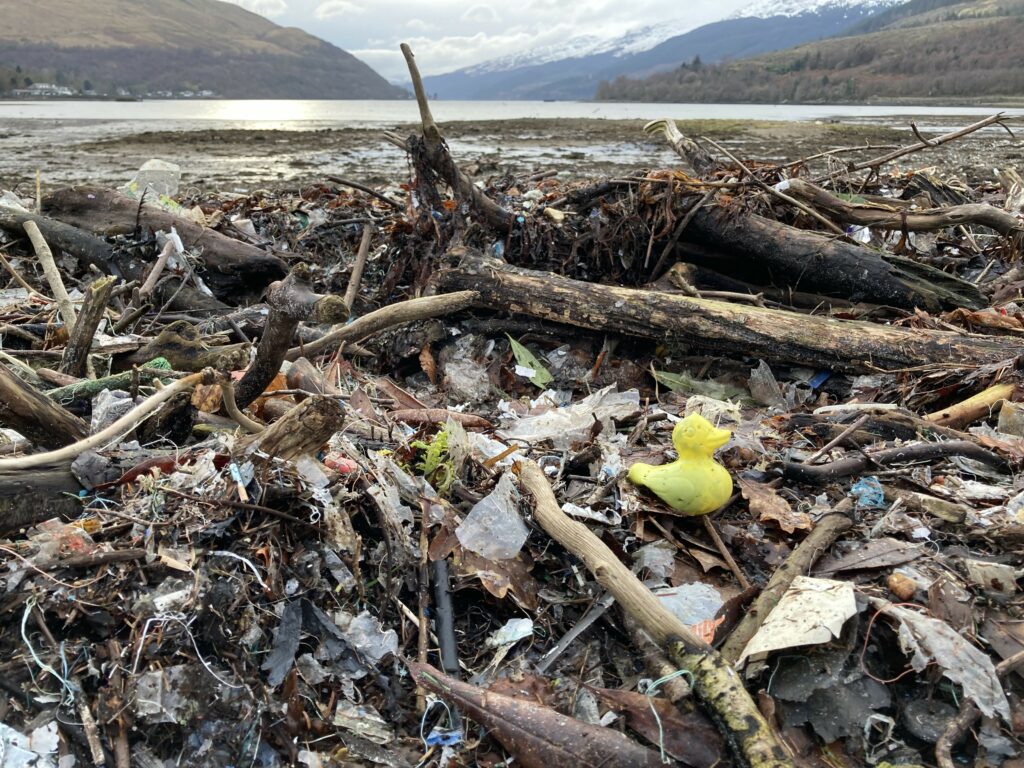
Due to a combination of topology, geography, prevailing winds, currents and more, marine-borne plastics/litter accumulates unevenly along coastlines, with some places developing into what are referred to as “litter sinks”. While there are significant efforts to reduce marine litter (through e.g. Keep Scotland Beautiful’s Upstream Battle and KIMO’s Fishing for Litter initiatives) there are certain places where large amounts of plastic have already been deposited and will continue to accumulate for many years. As plastics break up in the marine and shoreline environment, we face situations where smaller and smaller scraps of mixed plastics are embedded in matrices of wrack, marram grass and other plant matter. This admixture poses real challenges in relation to removal, separation and retention of both plastics and plant matter, both of which could (should) be seen as valuable resources. There are also challenges with removal due to remoteness and/or concerns about damaging local foreshore/shoreline ecosystems where mechanical removal is needed. The proposed event will use the village of Arrochar, Scotland’s highest-profile litter sink, and other places along the Scottish coast as examples to provoke novel, solutions-oriented thinking. We aim to generate new ideas relating to the following questions:
- How can large quantities of mixed plastic/other waste/vegetable matter be safely removed from shoreline environments?
- How can these materials be treated – for example to separate seaweed from plastics and clean both?
- How can these materials be used as resources – for example seaweed as compost or feedstock for bioplastics, plastics for recycling or waste-to-energy …?
- Can such processes be made to pay for themselves?
During the event, we:
- heard from some of those who are already grappling with the realities of beached marine litter in Scotland;
- heard Something Must Be Done, a new “fairy tale” version of the history of marine litter at Arrochar (a fairy-tale version of Arrochar and the Waste of the World);
- heard from a major research project on marine litter in Vietnam; and
- discussed what we need to do to find a sustainable way of managing the problems they encounter.
We will add resources shared and created through this event as they become available.
Presentations
We had presentations from Jacqui Willis (GRAB Trust Beaches & Marine Litter Project Officer), Vicki Last (Scottish Islands Federation Marine Litter Development Officer) and Nic Coombey (Solway Firth Partnership Project Officer).
Access Vicki’s presentation here:
Access Nic’s presentation here:
Access Something Must Be Done here:
This event is supported by the University of Glasgow’s Knowledge Exchange Fund and Centre for Research and Development in Adult and Lifelong Learning, the COAST-R Network, the GRAB Trust and the Solway Firth Partnership.